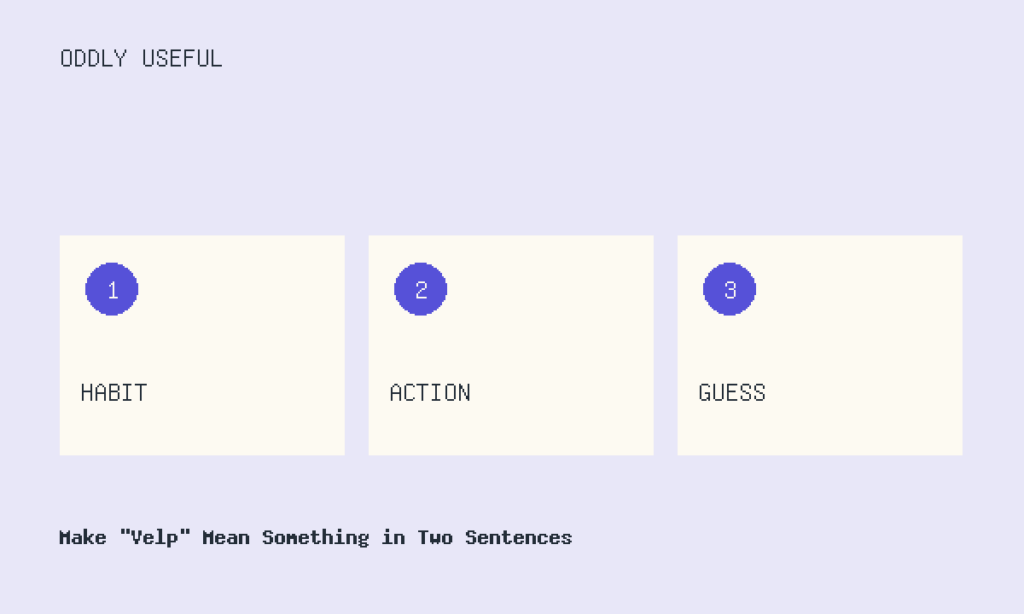
“The Orchard” becomes “Borrowed Apples,” then “October Teeth.” The title is getting somewhere. The story hasn’t started. In this hypothetical AI-assisted language exercise, fictional editor Nell coins “velp”: to keep renaming an unfinished creative project instead of working on it. Her task is to make that habit visible in two sentences without explaining the word.
Nell’s complete AI writing brief
Context: Velp means to keep renaming an unfinished creative project instead of working on it.

Write a two-sentence scene using velp once as a verb. Make its meaning inferable through observable actions. Do not define it or invent additional words.
The version that gives readers something to see
Nell’s finished revision reads: “Nell velped her unwritten story from ‘The Orchard’ to ‘Borrowed Apples’ to ‘October Teeth.’ Beneath the latest title, the page was still blank.”
The sentence pair supplies the exercise’s usable model: show a specific action unfolding, then show what that action leaves undone. A reader can inspect the evidence instead of having to trust that an unfamiliar word means something.
A prompt with a small, demanding job
Nell’s complete prompt is: “Write a two-sentence scene using velp once as a verb. Make its meaning inferable through observable actions. Do not define it or invent additional words.”
She supplies her intended definition alongside that instruction as context for the AI. The definition belongs in the writing brief; the reader will get only the scene. This separates what the writer knows from what the sentences actually communicate.
The illustrative draft, authored for this exercise rather than taken from an actual model response, reads: “Nell velped all afternoon. Her story remained unfinished.”
Why the first draft could mean almost anything
Nell notices that “all afternoon” establishes duration, while “remained unfinished” establishes a result. Neither reveals what she did. Velping could mean rearranging pencils, watching clouds, or polishing the same opening sentence. The draft suggests a distraction but leaves the distinctive habit out.
Her revision replaces elapsed time with successive titles. “From” and “to” make the changes legible, and the three names establish repetition. We can watch her attention move between versions of the same label.
The blank page does a different job. Renaming alone might be a useful part of writing a story. Here, the space beneath the increasingly elaborate title shows that the story itself has received no words. Together, the title sequence and the blank page point toward repeated renaming in place of making the work.
Let the reader’s guess expose the gap
A reader might still guess “fussing over titles” rather than Nell’s broader meaning, which applies to other creative projects too. That difference is useful evidence: two sentences can make a habit recognizable without communicating every boundary of a dictionary entry.
Coin a verb for another specific creative habit. Write two revealing sentences, then show someone the scene without your definition. Ask what they think the verb means and which details led them there. Compare their guess with your intended definition; revise the action that would close the most interesting gap.